

A crisp, defined jawline is the foundation of a youthful appearance. When patients look in the mirror and pull their skin back, they usually love what they see: a smooth angle and a tight neck. But for many, when they let go, the issue isn't just sagging skin or excess fat, it's a structural blockade that no amount of surface tightening can fix.
It's called the submandibular gland.
In the world of the deep plane facelift and the deep plane neck lift, handling this walnut-sized gland is often the difference between a "good" result and a truly contoured, high-definition outcome. Yet, it remains one of the most overlooked aspects of facial rejuvenation, largely because addressing it requires a level of surgical precision that many providers avoid.
Here's why the submandibular gland matters, and why treating it is often the missing link in perfecting your neck contours.
Your body possesses several salivary glands, but the submandibular glands sit directly tucked underneath the jawline, halfway between the chin and the ear.
In youth, these glands are high and tight, hidden behind the tension of the facial muscles and skin. However, facial aging is a cascade of descent. As the ligaments loosen and the "hammock" of deep tissues relaxes, the gland creates what surgeons call a ptosis—it drops.
This creates the specific contour irregularity known as the "Double Bubble":
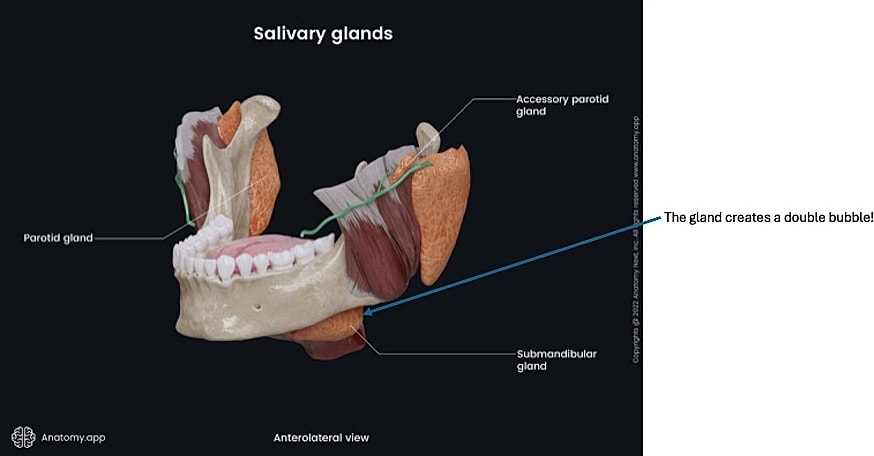
If you have a bulge in the neck area that persists even when you tilt your head back or tighten your muscles, you are likely seeing the gland, not just excess fat deposits.
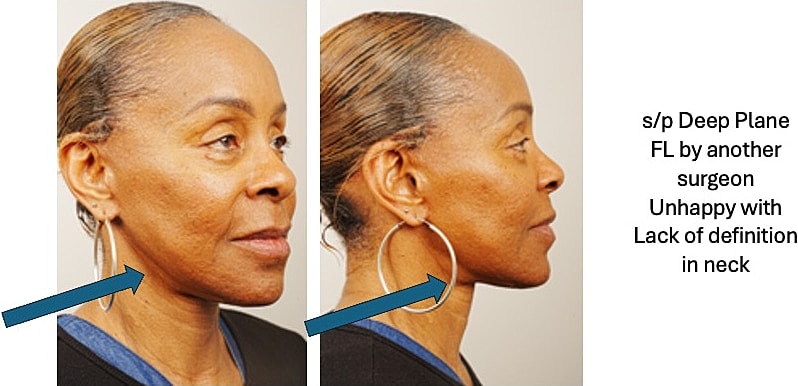
This is the most common frustration for revision patients: they underwent a traditional facelift or a standard SMAS facelift, the skin is tight, but the neck still looks "full," heavy, or they still have a small double chin.
The limitation lies in the anatomy. A deep plane facelift lifts the muscle (SMAS) and deeper structures to restore the upper portion of the face, cheeks, and jawline. A deep plane neck lift addresses the platysma muscle and deep fat pads. Maximal rejuvenation is typically seen when these two procedures are done together; however, the submandibular gland sits deeper than these muscle layers.
If a surgeon uses a standard facelift technique to tighten the muscle over a protruding gland without reducing the gland itself, the result is a smooth but bulky neck. You cannot flatten a bulge by simply tightening the sheet over it; you must resize the object underneath. Research in Plastic and Reconstructive Surgery confirms that for patients with gland ptosis, selective reduction is often the only way to achieve a clean, continuous jawline angle and truly natural appearance.
A properly performed facelift or neck lift technique paired with a submandibular reduction will offer results that leave you naturally sleek and beautiful.
Eliminates the “double bubble” shadow and enhances the mandibular border.
Creates a smooth transition from jawline to neck.
Avoids the mismatch between a rejuvenated lower face and a bulky neck.
Especially common in revision cases.
While you smooth out the bump that's creating a sort of double chin appearance, you're still getting all of the benefits from you main procedure, like smoothing deep wrinkles, getting rid of excess fat deposits and loose skin, minimal visible scarring (no extra visible scarring from the submandibular reduction since it is performed under the muscle layers during your deep plane neck lift), and generally less signs of aging, like lightened nasolabial folds and a more rested appearance from brighter upper eyelids.
How do we decide if the gland is blocking your path to a defined neck? It usually comes down to internal geometry. During your initial consultation, we evaluate the gland’s position relative to the "hyoid plane," an anatomical line connecting your mandible (jawbone) to the hyoid bone in your neck.
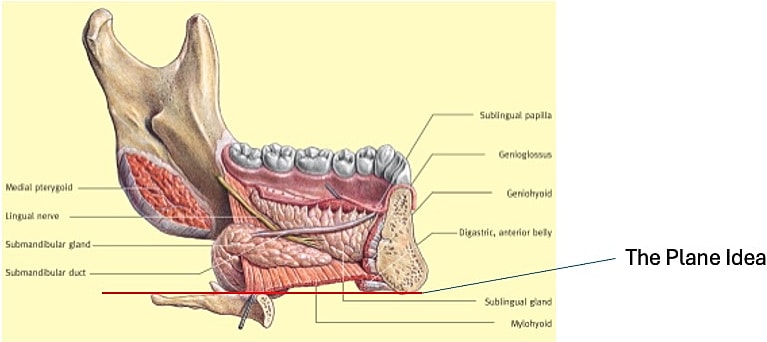
In youth, the gland sits high, but facial aging often causes it to drop. If the gland sits above this line, a standard neck lift or facial plastic surgery procedure can usually tuck it away. But if the gland is ptotic (droopy) and sits below this plane, no amount of tightening the connective tissues beneath will hide it. It will physically push against the new neckline, ruining the neck contours you are trying to achieve. This marker is the deciding factor; if the gland breaks that plane, reduction is the only way to get that straight, sharp contour.
There is a misconception that, unlike traditional neck lifts, the deep plane neck lift and facelift techniques fix everything simply because they go deeper. While it's true that an extended deep plane facelift and neck lift reposition the superficial musculoaponeurotic system (SMAS) and release the facial retaining ligaments to restore a more youthful appearance, they have a "floor."
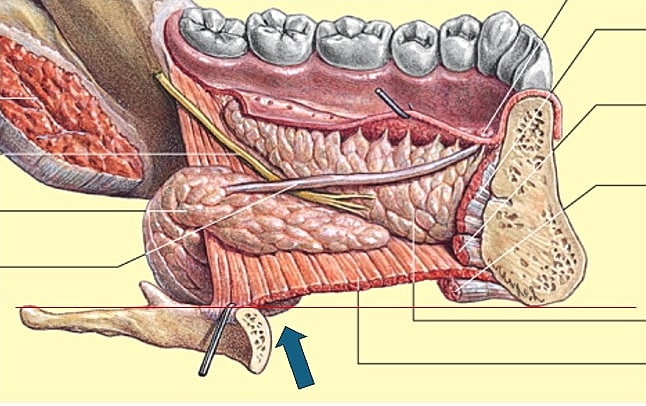
The submandibular gland sits beneath the muscular layer that a standard deep plane lift addresses. This means you can have a technically perfect deep plane facelift surgery, where the deep tissues are tightened, and the sagging skin is draped beautifully, maybe you even have neck liposuction done to clean up excess fat, but still have that bulge. The lift tightens the "ceiling" over the gland, but it doesn't move the gland itself. If the submandibular gland is heavy, it creates a fullness that disrupts overall facial harmony. Trimming away part of the gland itself is often the only way to guarantee that sculpted, sharp-angle definition.
After everything we’ve brought up, you’re probably wondering: if this step is so critical for a sharp jawline, why is it rarely offered? The hesitation usually comes down to comfort zones. Reducing the gland requires working in a very complex deep plane layer of the neck, often near the facial nerve, which general plastic surgeons may avoid.
It's an advanced surgical procedure that requires specialized training. Many plastic surgeons skip this step because they are concerned about potential complications like a "sialocele," a temporary collection of saliva under the skin. While this is rare in experienced hands, avoiding it requires precise technique. This is also why we emphasize following any and all pre- and postoperative care. Asking you to skip citrus and spicy foods for two weeks isn’t just a random suggestion, we want to keep the glands calm to prevent fluid buildup while the tissue seals.
Submandibular gland reduction is not about removing the organ entirely; it is a partial reduction (shaving) of the superficial portion of the gland that is causing the contour deformity.
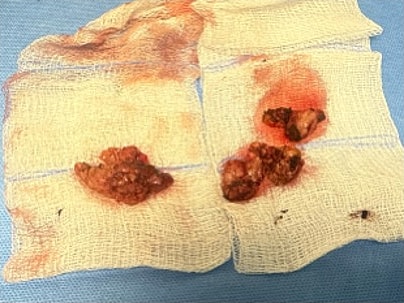
This is a technical, nuanced maneuver. It requires navigating deep neck anatomy, which is why it is best performed by a surgeon with specific training in Head and Neck surgery (Otolaryngology), rather than a general plastic surgeon.
The Ideal Candidate:
Deep plane facelifts and deep plane neck lifts are not surgeries to be taken lightly. The recovery is manageable, but it is intensive. Keeping your head elevated, staying hydrated, and following your surgeon's post-op procedures by the book are critical to maintaining long-lasting, natural results.
This is the primary hesitation for most patients, and the data are reassuring.
Saliva production is redundant. The parotid glands (in the cheek area) are the heavy lifters, responsible for the vast majority of stimulated saliva production. The submandibular glands contribute a much smaller fraction, but because we're only removing a portion of the gland, not the whole unit, it can still function like normal.
Many reviews in the Aesthetic Surgery Journal and other clinical studies spanning over 100 consecutive cases have demonstrated that partial resection has no significant long-term impact on oral moisture or function. The body adapts seamlessly.
Because this advanced surgical procedure occurs deep within the neck, the recovery mirrors that of a deep plane neck lift, with a few specific protocols. During postoperative care, we advise patients to avoid acidic or spicy foods for the first two weeks to keep salivary stimulation low while the tissue heals.
The most critical factor in this procedure is the surgeon’s background. The submandibular gland sits near the facial nerve and vessels that require expert navigation. As a Double Board-Certified Facial Plastic Surgeon with a background in Otolaryngology (ENT), Dr. Athré’s training focuses heavily on the deep structures of the neck, allowing for a safe, aggressive contouring that standard lifts cannot achieve.
Gland reduction isn’t for everyone, but for the specific neck that needs it, there is no workaround. Using a facelift procedure to tighten skin over a structural bulge just creates a tighter bulge. The real test of a facelift or neck lift shows up in the profile. When reviewing a surgeon's portfolio, look past the general refreshment and focus strictly on the transition from chin to neck. You want to see a crisp, defined right angle rather than a diagonal slope. That sharp contour is the signature of a surgeon who addressed the deep architecture rather than just smoothing out the surface.
Take a Look at our Deep Plane Facelift Gallery